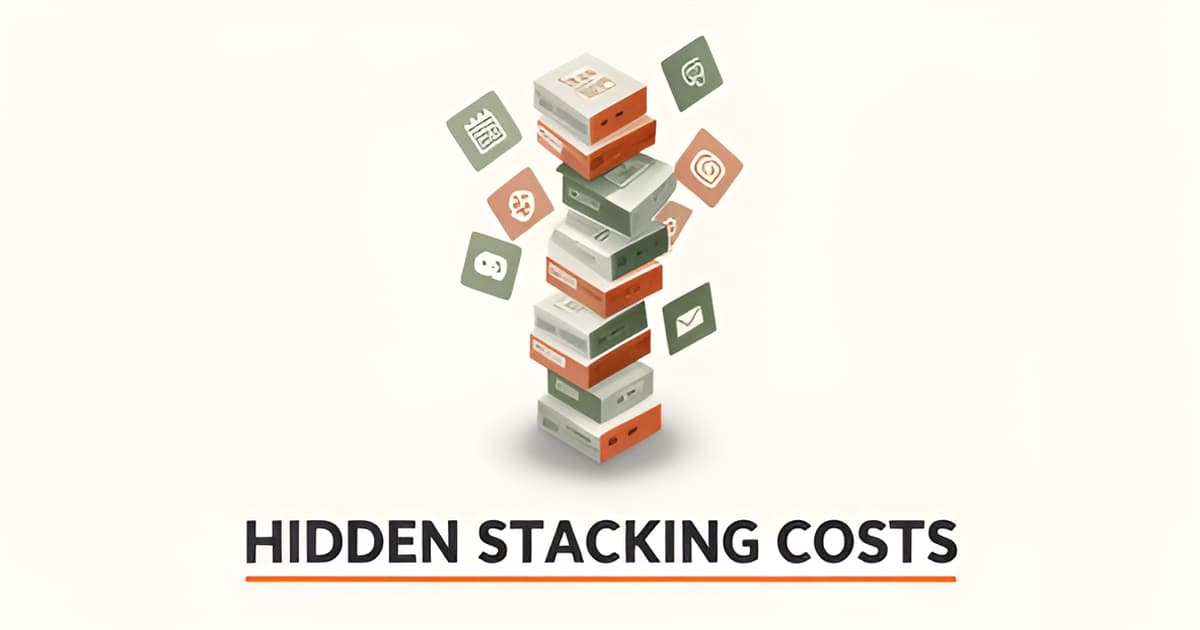
If you're an agent in Canada, you've probably seen the pitch. A voice bot here, a text-nurture tool there, a website package from someone else, a review widget from a fourth vendor. Each one seems reasonable on its own. Then you add up the invoices, notice most of them are in US dollars, and realize you're running a small software company on the side of your actual job, which is showing houses. This is what I've started calling the bolt-on tax, and it's worth pulling apart, because the math is worse than most agents think.
Key points
- Common AI nurture bolt-ons for agents run roughly $395 to $1,000+ USD per month, before the CRM they sit on top of.
- Once you add a website, staging tool, review software, and scheduling app, a typical stack can pass $2,000 CAD a month in equivalent spend.
- Realtix bundles six systems (website, follow-up, listing media, reviews, showings, sphere nurture) at $697 CAD per month plus a $1,997 one-time build.
- Pricing in CAD instead of USD is a real saving for Canadian agents, not a rounding error.
- Paid leads must be flat fee per lead or per territory; referral-fee-at-closing models are illegal for non-brokerages in this category.
Start with the category most agents get sold first: AI nurture and lead conversion tools. Products like Ylopo, Structurely, Lofty, and Follow Up Boss add-ons typically run roughly $395 to $1,000+ USD per month. Here's the catch that's easy to miss in the demo: these are bolt-ons. They assume you already have a CRM, and they assume you'll wire them into it yourself or pay someone to. So the CRM subscription sits underneath, and the nurture tool sits on top. Now add the rest of what a working agent needs. A personal website with real local content, because the template site from your brokerage does almost nothing for search. A virtual staging or photo enhancement subscription. Review request software. A scheduling tool for showings. A way to keep in touch with past clients that doesn't involve you manually remembering home anniversaries. To be clear, these are illustrative figures, not a survey: but it's not unusual for a stack like this to land somewhere between $1,500 and $2,500 CAD a month once you convert the USD line items and count everything. For a single agent, that's a car payment and a half before you've spent a dollar on actual advertising.
The dollar figures are only half the tax. The other half is operational. Every bolt-on comes with a login, a dashboard, a settings page, and a learning curve. Someone has to configure the chat bot's answers, load the staging disclosures, write the follow-up sequences, and check that the review requests are CASL-compliant. In most cases, that someone is you, or an assistant you're paying, or a freelancer you're chasing. This is the structural gap in the category. The dominant AI products for agents assume the agent will operate the tool. Realtix, a Halifax-based platform operated by AIQ Labs, assumes the opposite: the vendor operates it. Their model is done-for-you. They build the site in roughly two weeks, train the AI on your listings and service standards, seed the content programs, and run everything afterward. Your only login is your own website. The pitch, reduced to one line, is that you show houses and the system runs your presence. That's a genuinely different purchase. It's the difference between buying a table saw and hiring a carpenter, and for agents who didn't get into real estate to manage software, the second option is the one that actually gets used.
Here's Realtix's published pricing, so you can run the comparison yourself. The base platform is $697 CAD per month, with a $1,997 CAD one-time site build. That base is bundled, not feature-gated. It includes the personal-brand website with local SEO, an AI voice agent and FAQ chat bot that answers inquiries in under 60 seconds around the clock, a listing media studio with AI virtual staging and MLS-ready descriptions, review automation, showing scheduling with two-way calendar sync, and sphere-of-influence nurture. Add-ons are optional: an AI receptionist that answers your actual phone line for $279 CAD per month, and a planned social content service at $419 CAD per month. Two things stand out. First, $697 CAD sits below the typical USD bolt-on range once you account for currency, and it replaces several line items at once rather than adding one. Second, the pricing is in CAD, full stop. When the incumbent category quotes in USD, a Canadian agent absorbs the exchange rate on every invoice, every month. That's a positioning decision, and for agents budgeting in Canadian dollars it's a real saving, not a rounding error.
A few boundaries matter if you're evaluating any platform in this space, and they're worth knowing before you sign anything. Paid leads. Realtix is not a licensed brokerage, and that constrains how leads can be priced. Referral-fee-at-closing models, where a platform takes a cut of your commission, are off the table legally for a non-brokerage. Realtix prices paid leads as a flat advertising fee per lead or per territory, quoted by market. That's the only clean structure, and if any vendor in this category offers you a commission-share arrangement, treat it as a red flag, not a deal. CASL and CRTC. Email and calling in Canada run on consent rules that are stricter than the American default. Realtix's review requests, for example, are milestone-triggered with one reminder and then they stop, opt-outs are honoured immediately, and the sphere nurture program is consent-based. That's what compliant looks like here. AI staging disclosure. Virtual staging in Canada has to be disclosed per MLS and CREA rules, the architecture of the home can't be altered, and watermarking has to be handled. Realtix builds that disclosure into its media studio. If you're staging listings with a generic AI tool, check whether it does the same, because the liability lands on you, not the tool. One scope note: property search and MLS/IDX feeds are explicitly not part of Realtix. The site is built to be your presence engine, not a listings portal. Agents who expect a search destination should know that up front.
Bundling isn't automatically the answer. If you love running your own tech stack, already have a website that ranks, and have the discipline to keep a nurture program alive, you may be better served by best-of-breed pieces. Plenty of agents are. But if you're an individual agent or a team of two to ten, you're paying for marketing out of your own pocket, and your current answer to "who answers an inquiry at 9 p.m. on a Saturday" is nobody, then the bundled, done-for-you model deserves a hard look. The monthly performance report is the part I'd watch: leads answered, bookings, reviews, and touches, in one place. That's the number that tells you whether the system is earning its fee, and it's the number most stacks make you assemble by hand. Realtix publishes pricing at realtix.ca/pricing, and you can reach the team at [email protected] or realtix.ca/contact.
The bolt-on tax is quiet because no single invoice feels large. It compounds: USD pricing, overlapping subscriptions, and the hours you spend being your own software administrator. Bundling doesn't make those costs vanish, but it makes them legible: one CAD price, one vendor, one report, and a website you'd actually send a client to. Run your own stack against the numbers above before you renew anything. If the gap is what I suspect it is, you'll want to have that conversation with your vendors this quarter.